The chain is one of the oldest and most interesting forms of jewellery in human history, rich in both decorative value and cultural meaning. At Thomas Glover, we’re exploring how chain necklaces have evolved over the centuries and discussing our favourite styles of chain.
Ancient Origins
The earliest surviving metal chains date back more than 4,000 years. The technique known as loop-in-loop chain emerged during the 3rd millennium BC. Goldsmiths formed individual loops of precious metal, folded them and threaded them through one another, creating a flexible chain. By the early 2nd millennium BC, Minoan goldsmiths were making gold chains using techniques including hammering, casting and fine wirework. These techniques spread along trade routes across the ancient world.
Chains developed to suspend amulets and charms associated with religion and protection. As Christianity spread, crosses were worn from chains as expressions of faith. By the medieval period, heavy gold chains had also become visible symbols of wealth and status.
Gold chain with lion's head clasp, 3rd BC, excavated Cyprus, British Museum.
Renaissance & Status
From the 14th century onwards, gold chains were one of the most fashionable forms of jewellery. Heavy chains were worn alone or used to suspend lavish pendants depicting biblical scenes, coats of arms and allegorical motifs, serving as both ornament and portable displays of wealth. Women would layer more simple chains over their clothing, while men favoured larger and more imposing styles.
Charles d'Amboise in the cockleshell collar of the Order of Saint Michael, 1507
The Renaissance fascination with innovation extended to jewellery and goldsmithing. Leonardo da Vinci even produced drawings exploring chain mechanisms and devices for making chains. At the same time, chains became part of the visual language of power, with portraits across Europe showing sitters wearing multiple gold chains as expressions of their status or allegiances.
Henry VIII famously championed the fashion for chains. In portraiture, he was regularly portrayed wearing massive gold chains as symbols of his personal magnificence and the extraordinary wealth of the Tudor court. Chains were also given as gifts of royal favour and allegiance. Across Europe, noblemen and even wealthy merchants embraced the fashion, using substantial gold chains as declarations of their prosperity.
Bia di Cosimo de’ Medici, daughter of Cosimo I de’ Medici, by Agnolo Bronzino, 1542.
Decorative & Functional Chains
During the 17th century, chains became lighter and more delicate, reflecting a broader change in the way jewellery was worn. While the heavy gold chains of the Renaissance had been conspicuous displays of wealth and rank, finer chains were used to suspend smaller, more personal jewels. Portrait miniatures, lockets and other sentimental objects could be worn close to the body, giving the chain a new role as the means of carrying something, or someone, of personal significance.
During the Georgian period chains were used in everyday life. Watches, seals, keys, vinaigrettes and other small personal objects all needed to be carried, and goldsmiths responded by creating chains that were both practical and decorative. Georgian chains range from relatively simple links to wonderfully intricate handmade examples, with belcher, trace, rope and fancy links appearing in numerous variations. The growing popularity of the pocket watch was particularly important. Watches were valuable possessions as well as fashionable accessories, and chains provided a practical means of securing them while allowing them to be displayed as part of an outfit.
Georgian Gold Chain c.1780
Georgian long chains became known as guard chains. They would often measure 50 inches or more. They could be worn in a single long loop or doubled and tripled around the neck, and they were used to suspend watches and other useful objects, including vinaigrettes and lorgnettes. A type of Georgian long chain is the muff chain. Muff chains were worn around the neck, then passed through a lady’s hand warmer and attached at the end, thus suspending the muff. Surviving examples appear in many forms, from simple belcher and curb links to elaborate rope, fetter and fancy-link designs. Versatility is one reason they remain so wearable today as a chain designed two centuries ago to carry a watch or accessory can now be doubled around the neck, layered with other chains or used to suspend a pendant.
Georgian Guard Chain with Hand Clasp c.1800
Victorian Chains
Advances in manufacturing during the Victorian era transformed chain production, greatly expanding the variety of styles available. Curb, belcher, fetter-and-three, trombone, rope and box chains appeared alongside an ever-growing range of elaborate fancy links, and all links could be found in gold and silver.
Chains were not just decorative, but also functional. Women suspended everything from lockets, watches, vinaigrettes, scent bottles, and lorgnettes from chains, while chatelaines let them carry keys and useful household objects from the waist. For men, the highly fashionable pocket watch was suspended from an Albert chain. Traditionally, an Albert chain featured a T-bar which passed through a waistcoat buttonhole to anchor the chain, with a swivel or dog clip securing the pocket watch inside a waistcoat pocket. Many also included a short drop from which a decorative fob, seal, watch key, sovereign case or other small object could be suspended. You can read more about Albert chains in our article here.
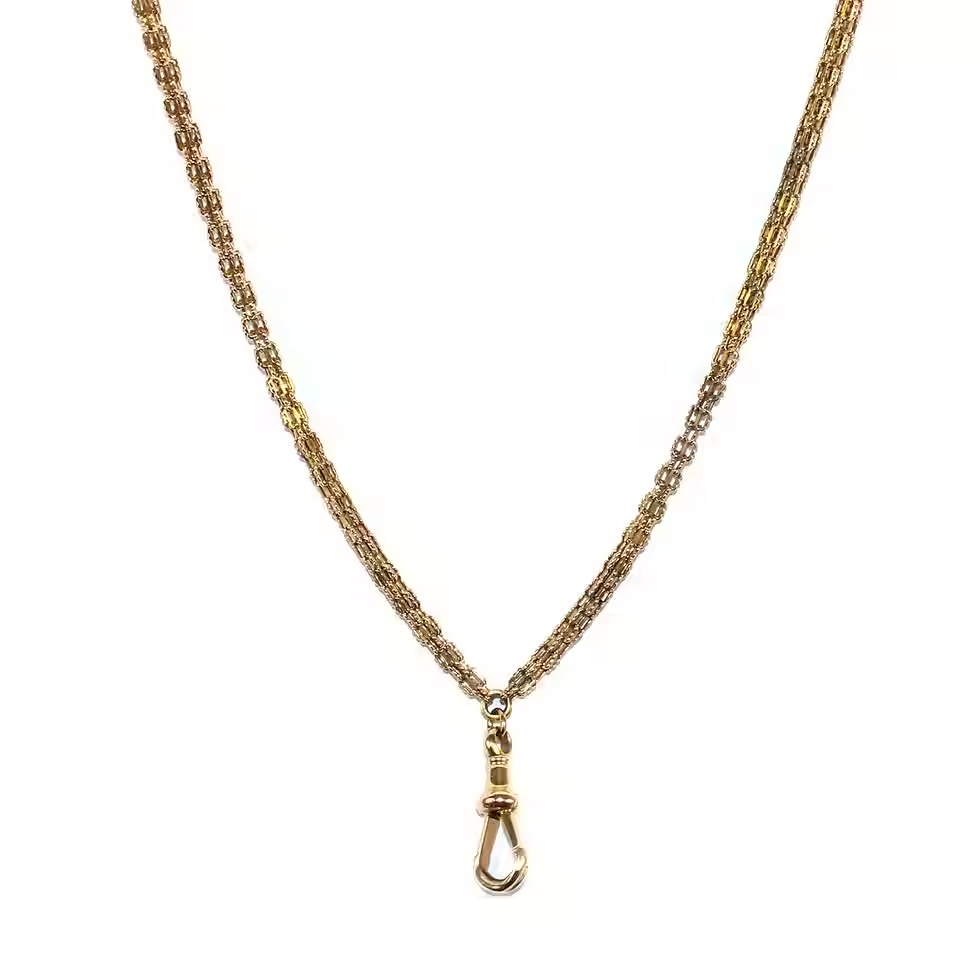
Victorian gold guard chain c.1890
20th Century Transformations
During the Edwardian period, delicate platinum and gold chains were popular, suspending diamond, pearl and gemstone pendants or lavalieres and complementing the light, intricate jewellery of the era. Chains remained an essential part of a jewellery collection, whether in the form of the pocket-watch chain worn by an Edwardian gentleman or the long, waist-length necklaces that became fashionable during the 1920s. Art Deco brought a more geometric approach, with long sautoirs and stylised links reflecting the period's new aesthetic.
Edwardian 15ct Gold Guard Chain c.1910
The Second World War brought shortages and restrictions on precious materials, forcing jewellers to adapt. Jewellers produced lighter chains in silver and other metals, while designs that created an impression of volume without requiring large quantities of gold were common. Tubular chains such as tubogas, formed from tightly coiled strips of metal, created a substantial, flexible appearance while using relatively little precious metal.
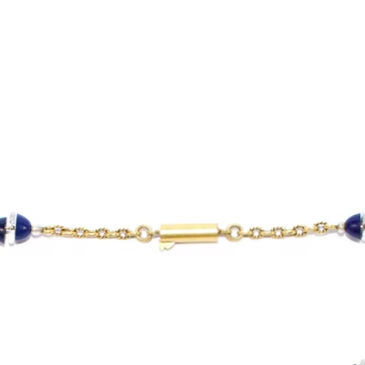
Art Deco Natural Pearl Chain c.1930
The 1940s and 1950s saw substantial yellow gold return to fashion, with flexible gas-pipe chains, woven designs and chunky interlocking links creating necklaces and bracelets with a strong sculptural quality. Italian goldsmiths in particular became celebrated for sophisticated chain-making. During the 1960s and 1970s, chains became more expressive. Oversized curb links and textured gold reflected the fashions, while designers experimented with scale and movement. At the same time, chains began to form part of the visual language of emerging countercultures. Hippies wore long chains with symbolic or spiritual pendants, while punk adopted lengths of metal chain as part of its deliberately hard-edged aesthetic. From the late 1970s onwards, substantial gold chains also became associated with hip-hop, where they developed into powerful expressions of both success and personal style.
Retro Gas Pipe Flexible Tubogas Collar Necklace
Today, almost every historical form of chain remains in use. Antique guard chains are layered with contemporary necklaces, Albert chains are worn around the neck or wrist, and traditional curb, belcher and rope links continue to be made by modern jewellers. Few forms of jewellery have proved quite so adaptable, which perhaps explains why, after thousands of years, the chain remains as essential as ever.
Antique Chain Links
Antique chains come in an extraordinary variety of forms, from simple hand-worked links to elaborate constructions designed to be decorative in their own right. Knowing the terminology can help when identifying, dating and collecting antique chains.
Anchor or mariner - inspired by the heavy chains associated with ships and anchors, mariner chains feature oval links divided by a bar through the centre. The style can vary considerably, from substantial utilitarian-looking links to much finer versions designed for necklaces and bracelets.
Belcher or cable - a classic chain consisting of rounded links, usually wider in proportion than those of a trace chain. Belcher links can range from relatively fine to quite substantial, and may be plain, faceted or decoratively engraved.
Box or Venetian - made from closely connected square or box-shaped links, box chains have a smooth, geometric appearance while remaining flexible. Antique examples were more decorative than the modern box chain, with pierced, engraved or patterned sections.
Curb - formed of round or oval interlocking links twisted until they are flattened out. Sometimes fed through a rolling mill to create a true flat chain. Curb chains can be either hollow or solid and can be interlocked with other link styles. Antique examples can vary enormously, from tightly constructed graduated chains to broad, substantial links.
Fancy - fancy chain is a broad term for chains incorporating decorative or unusual links. Victorian and Edwardian goldsmiths produced an enormous variety, combining different link shapes, engraving, pierced work, textured surfaces and contrasting sections.
Fetter - fetter-and-three alternates an elongated link with a sequence of three smaller round links, often found in Victorian and Edwardian watch chains and necklaces.
Rope - constructed to create the appearance of strands twisting around one another. They range from fine to substantial statement pieces. Rope chains have appeared in jewellery in various forms over centuries.
Snake - made from tightly connected components that create an almost continuous, smooth surface rather than clearly visible individual links. They are flexible and fluid and were fashionable in the 19th century, when snake jewellery itself carried associations of eternity and everlasting love.
Trace - a simple chain made from fine, uniform round or oval links. Trace chains are lighter and more delicate than many other antique chain styles and often used to suspend pendants or lockets.
Trombone - formed of long links separated by smaller connecting links. Often found in Albert chains, long chains, necklaces and bracelets. Antique examples are often beautifully engineered and may incorporate decorative or faceted links.
Antique Chain Fittings
The fittings on an antique chain can be almost as interesting as the links themselves. Clasps, clips and T-bars were functional components, but they were also opportunities for the goldsmith to add decorative detail. They can also provide useful clues when examining the age and original purpose of a chain.
Bolt ring - a circular spring-loaded fastening operated by a small lever. Bolt rings became common during the 19th century and appear on necklaces, bracelets and watch chains.
T-bar - in T shape, originally designed to pass through the buttonhole of a gentleman's waistcoat on an Albert chain, securing the watch chain in place.
Swivel - a rotating fastening found on watch chains, allowing a watch, fob or other object to be attached while reducing twisting of the chain.
Barrel clasp - a cylindrical fastening in which the two ends of the chain connect to form a small barrel shape.
Box clasp - a fastening in which a sprung tongue slides into a box-shaped housing. They were widely used in antique necklaces and bracelets.
Gem-set clasp - on more elaborate necklaces, the fastening was sometimes hidden within a gem-set element so that it did not interrupt the design of the jewel. Associated with pearl or rivière necklaces.






Comments