In this article we explore the history of sweetheart brooches. Sweetheart brooches emerged during the First World War, worn as reminders of loved ones serving away from home. Intended to bridge the physical and emotional distance between soldiers at the front and those waiting for them, they would be worn until a man’s return and carried a sense of hope and expectation. One that was, heartbreakingly, not always fulfilled.
They were created as miniature replicas of military regimental badges, naval insignia, or RAF emblems and served as romantic keepsakes given by servicemen to wives and girlfriends before leaving for the front. Their presence quickly became a familiar part of wartime dress, and they provided a means to show that your loved one was ‘doing their bit’ for king and country. Such brooches were sold widely in retail and jewellery stores and in small shops set up in military camps, where last-minute gifts could be purchased before embarkation. Worn publicly, they allowed families to visibly express pride, loyalty and support during what were often long and uncertain periods of separation.
Edwardian Naval Crown Sweetheart Brooch, c.1904
A fine Edwardian gold naval crown sweetheart brooch, representing an early example of sweetheart jewellery and given as a personal token to signify service in the Royal Navy. Dating to the Edwardian period and predating the First World War, it was created during peacetime service, when extended naval postings still involved long periods of separation. Engraved to the reverse ‘Lilly from Fred 11.2.1904’, this beautifully preserved brooch is an evocative piece of sentimental jewellery, valued for both its condition and its intimate personal history.
During World War 1, many of these brooches were made by soldiers themselves. The practice of servicemen producing decorative or souvenir objects in their spare time was already well established. During the Crimean War, soldiers made items such as inkwells from cannon balls and during the Boer War, soldiers made small items such as vases using the brass casings from artillery, engraved with details of battles or inscribed as a ‘souvenir of the war’ and kept as decorative mementos. Such items became known as trench art: objects made from the materials of war and transformed into keepsakes of love and remembrance.
Edwardian Diamond Kings Royal Rifles Sweetheart Brooch c.1910
An unusual Edwardian sweetheart brooch designed as the cap badge of the King’s Royal Rifle Corps. Formed as a Maltese cross surmounted by an imperial crown, with a central enamelled roundel inscribed ‘The King’s Royal Rifle Corps’ and the regiment’s stringed bugle marked ‘60’. Finely enamelled and set with rose-cut diamonds, this platinum and gold brooch dates to c.1910 and is a refined early example of sweetheart jewellery, worn as a personal token of service and pride.
As the strain of the Great War made keeping in touch with loved ones back home seem even more important, soldiers sought ways to maintain a tangible presence in the lives of those they had left behind. They adapted regimental badges into pins and lockets to gift to wives and girlfriends, transforming official symbols of service into intimate objects. These pieces later became known as ‘sweetheart jewellery’.
Although the widespread popularity of sweetheart brooches belongs firmly to the First World War, the idea of adapting regimental insignia into jewellery predates the conflict. The earliest known example can be traced to a gold, diamond and enamel brooch in the form of the insignia of the 10th Royal (Prince of Wales’ Own) Hussars, commissioned by the Earl of Airlie as a wedding gift for his wife, Mabell, on 19 January 1886. Lady Airlie recorded in her diary that she believed she had started a new fashion - a claim that appears to be well founded. Earlier examples of sweetheart brooches exist, but it was during the First World War that they became widely accessible.
Art Deco Fleet Air Arm Sweetheart Brooch c.1935
An Art Deco sweetheart brooch representing the Royal Navy Fleet Air Arm, the aerial warfare division of the Royal Navy responsible for naval aviation and aircraft carriers. Designed as a pilot’s wing motif, the gold brooch features a silvered anchor within a green enamel laurel wreath, surmounted by a red enamelled King George VI crown and flanked by feathered wings. Dating to c.1935, this well-preserved example retains its original integral safety clasp and shows no damage to the enamel.
As the war progressed, the jewellery trade increasingly recognised both the emotional resonance and commercial potential of these pieces. Jewellers began producing sweetheart brooches using miniature regimental badges or service crests, transforming what had begun as improvised, personal keepsakes into a widely recognised form of jewellery. These brooches were made at every level of affordability. From simple base-metal pins to finely crafted examples in gold, silver, enamel and even diamond-set platinum, they allowed soldiers of all ranks and means to gift sweetheart brooches.
Sweetheart brooches were worn by wives, fiancées and girlfriends. For unmarried couples, they acted almost as an engagement ring, showing commitment to their sweetheart away fighting for king and country. They were worn with pride, frequently to church or public gatherings, signalling both personal loyalty and patriotic support. Their designs are rich in symbolism. Alongside regimental insignia appear hearts, ribbons, ivy trails, horseshoes and inscriptions referring to remembrance, faith, hope and good luck.
Large Diamond RAF Sweetheart Brooch c.1950
An unusually large Royal Air Force sweetheart brooch, finely made in white gold and set throughout with diamonds. The design features a realistically detailed, outstretched diamond-set RAF eagle and wings, mounted on a green enamelled gold laurel wreath and surmounted by a red enamelled King’s crown.
The brooch is accompanied by its original fitted case from Asprey & Co Ltd and the original purchase receipt dated 21 February 1966, recording its sale by Asprey & Co, London, for £225 - an exceptional survival that adds significantly to its historical interest.
The visible and tangible presence of these brooches in the everyday lives of women across all levels of society created a powerful link between front-line personnel and civilians on the home front. Yet they communicated more than romantic devotion alone. Sweetheart brooches also expressed broader social and cultural themes, including status, solidarity and patriotism. Contemporary newspaper accounts describe how they were worn as talismans, believed to bring good luck and ensure a soldier’s safe return, reuniting the brooch with the original insignia that inspired it.
Over time, however, the meaning of these brooches was shaped not only by public display but by personal experience. For some women, a sweetheart brooch remained a valued reminder of connection and service, worn long after the war. For others, the same object became too closely tied to difficult memories and would have been discreetly set aside, preserved but removed from daily life. These differing responses help explain why many sweetheart brooches survive today without detailed provenance. They would have been kept, but the stories attached may have been far too difficult to talk about and pass on. In this sense, such pieces are hugely emotive objects.
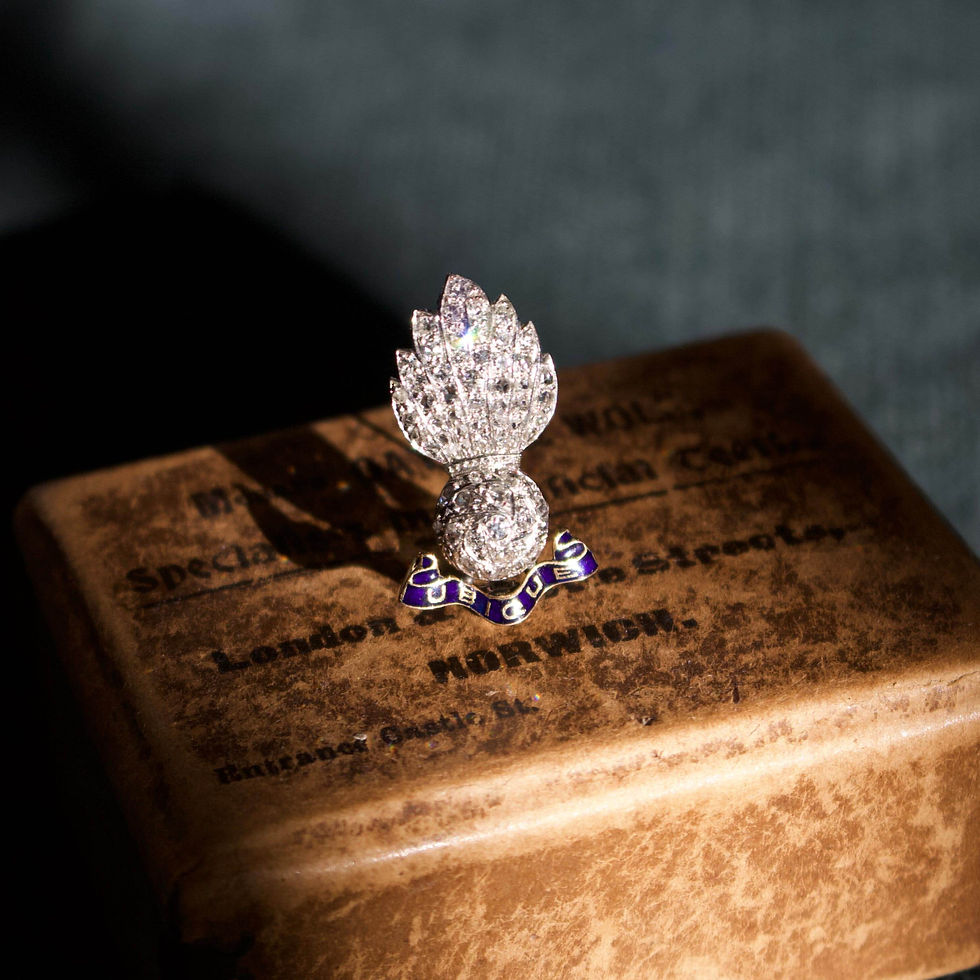
Diamond Royal Artillery Sweetheart Brooch c.1930
A fine diamond-set Royal Artillery sweetheart brooch dating to c.1930, designed as the regiment’s distinctive seven-flamed grenade. The brooch is set throughout with diamonds and finished with the Royal Artillery motto ‘Ubique’ (‘everywhere’) in blue enamel, a reference to the regiment’s historic role supporting British forces across all theatres of war. Reflecting the collar flash worn on an officer’s dress uniform, this finely made brooch retains its hand-crafted safety catch to the reverse and remains in excellent condition.
The tradition continued into the Second World War, when sweetheart jewellery remained an important expression of both patriotism and personal attachment. No longer worn solely by romantic partners, these pieces were also worn by mothers, sisters and other family members, each reflecting the branch of service in which a loved one was serving.
Every sweetheart brooch tells a different story, combining the identity of a particular regiment with a private bond between two individuals. As objects, they carry traces of individual lives, relationships and periods of separation, giving them a uniquely human quality. Today, sweetheart brooches are valued for both their historical significance and their emotional resonance. Positioned between military insignia and personal jewellery, they provide insight into how love, loyalty and identity were expressed through jewellery during the 20th century.
At Thomas Glover, we have always taken great pride in having a selection of genuine antique and period sweetheart brooches in our collection. We have military connections within our families and feel strongly that selling these wonderful items brings a sense of reuniting them with new owners who will take them to future generations of those who serve. Please get in touch if you are looking for something specific.




Comments